Is Delhi Changing Where Citizens Can Protest? Jantar Mantar Debate

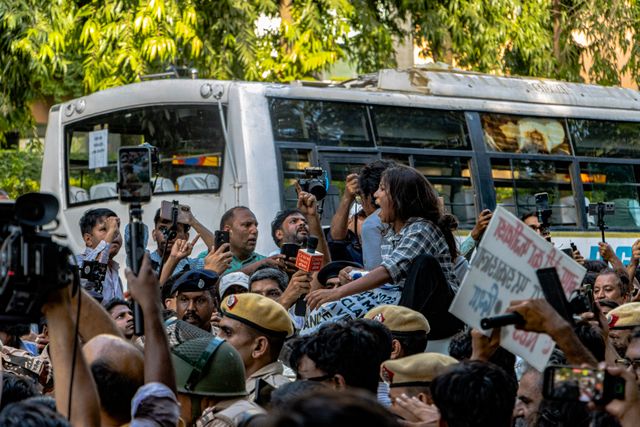

Jantar Mantar has long served as one of New Delhi’s most recognisable spaces for public protest. Students, workers, farmers, political groups, and civil society organisations have gathered there to demand action from the government. Its location in central Delhi has given demonstrations visibility and brought public grievances closer to the institutions responsible for addressing them.
That arrangement changed in October 2026. Delhi Police removed Jantar Mantar from the list of designated protest venues and identified Ramlila Maidan, Burari Ground, and CBD Ground in East Delhi as alternative locations. The decision followed controversy over protest permissions, security restrictions, and demonstrations demanding the resignation of Chief Election Commissioner Gyanesh Kumar.
The change has raised a fundamental question: is Delhi simply relocating demonstrations to improve public safety, or is it changing how citizens exercise their democratic right to protest?
Authorities argue that demonstrations must be managed to protect public order, traffic movement, and sensitive government establishments. Protesters and civil liberties advocates, however, worry that moving demonstrations away from central Delhi could reduce their visibility and make it harder to communicate demands to decision-makers.
The debate cannot be resolved by treating either public safety or protest rights as absolute. Delhi needs workable arrangements that protect both. The crucial question is whether the new system will regulate demonstrations fairly or create additional barriers to peaceful dissent.
Why Jantar Mantar Became a Symbol of Public Protest
Jantar Mantar’s importance extends beyond its physical location. Situated in central Delhi, it has become associated with citizens seeking attention for issues ranging from corruption and employment to public policy, social justice, and government accountability.
A protest’s location can influence how effectively it communicates its message. Demonstrations near government institutions attract attention from policymakers, journalists, and the public. Their visibility can help people who lack access to formal political channels bring neglected concerns into public discussion.
Jantar Mantar offered a recognised space for such demonstrations. It was not an unrestricted area where every gathering could proceed without permission. Delhi Police had established rules governing applications, timing, duration, and conditions for public programmes. The previous framework, issued through Standing Order No. L&O/48/2022, generally restricted demonstrations to specified hours and prevented programmes from continuing beyond one day.
This arrangement attempted to balance competing needs. Protesters could organise demonstrations at an established location, while authorities could plan for crowd management and reduce disruption to surrounding areas.
However, a designated site can become a practical limitation when its capacity, facilities, or security arrangements do not suit a particular gathering. Large demonstrations may create congestion, require extensive policing, and place pressure on nearby roads and public transport.
The debate therefore involves more than preserving a familiar protest location. It concerns the relationship between the physical geography of a city and the ability of citizens to make their demands visible.
What Changed in October 2026?
The immediate background to the decision involved demonstrations organised by the Cockroach Janta Party, which demanded the resignation of Chief Election Commissioner Gyanesh Kumar over alleged irregularities in the Special Intensive Revision of electoral rolls. The party sought permission for a protest at Jantar Mantar, but Delhi Police denied permission for the proposed October 10 gathering, citing short notice and other concerns. The application had reportedly been submitted only three days before the planned demonstration, despite the requirement to apply at least ten days in advance.
The dispute unfolded amid heightened security measures, restrictions on movement, and questions about the proportionality of police action. The Supreme Court intervened as petitions challenged measures affecting transport and the treatment of protesters. It stressed that public safety concerns should not lead to indiscriminate restrictions on ordinary movement or unlawful detention of peaceful demonstrators.
On October 9, the Supreme Court also called for authorities to reconsider Delhi’s decades-old arrangement for demonstrations at Jantar Mantar. It emphasised the need for a larger, better-equipped protest venue with basic facilities, including toilets, drinking water, medical support, and suitable shelter. The court indicated that an alternative location should allow peaceful demonstrations while protecting public safety and emergency access.
Delhi Police subsequently issued a new order on October 12, removing Jantar Mantar from the designated protest sites. It named Ramlila Maidan, Burari Ground, and CBD Ground in East Delhi as alternatives. The move marked a significant shift in the administrative framework for demonstrations in the capital.
The change does not mean that the constitutional right to protest has been removed. Instead, it changes the locations officially designated for demonstrations. However, its practical effect will depend on how the alternative sites operate, how permissions are granted, and whether citizens can access these spaces without unreasonable difficulty.
The Constitutional Right to Peaceful Protest
The right to protest in India is closely connected to two fundamental rights under the Constitution. Article 19(1)(a) protects freedom of speech and expression, while Article 19(1)(b) protects the right to assemble peacefully and without arms.
These rights allow citizens to express disagreement, organise collectively, and challenge government decisions through peaceful public action. Protests can make grievances visible when ordinary political channels appear ineffective or when an issue demands urgent attention.
However, these rights are not unlimited. Articles 19(2) and 19(3) permit reasonable restrictions on specified grounds, including public order. Authorities can regulate assemblies, impose lawful conditions, and take proportionate measures when credible risks arise.
The distinction between regulation and prohibition is central to the Jantar Mantar debate. The government can establish rules about crowd size, timing, routes, sound levels, and access to sensitive areas. It cannot treat the existence of a protest as sufficient reason to eliminate the right in practice.
In Himat Lal K. Shah v. Commissioner of Police (1973), the Supreme Court recognised the state’s authority to regulate public meetings on streets while rejecting an unrestricted power to deny them arbitrarily. Later, in Mazdoor Kisan Shakti Sangathan v. Union of India (2018), the Court examined restrictions affecting protests at Jantar Mantar and required a balance between demonstrators’ rights and the interests of residents and commuters.
These principles remain relevant after the 2026 change. A designated protest venue can help authorities manage demonstrations, but the framework must still provide a meaningful opportunity for peaceful assembly.
The legal question is therefore not whether Delhi can designate alternative sites. It is whether the new arrangement remains reasonable, accessible, and consistent with constitutional protections.
Why the Government Wants Alternative Protest Venues
Central Delhi contains important government offices, major roads, and sensitive public institutions. Large demonstrations can affect traffic, emergency access, nearby businesses, public transport, and the daily movement of residents and workers.
Authorities must also consider the size and nature of an expected gathering. A venue designed for a limited number of participants may become unsafe if attendance exceeds its capacity. Inadequate sanitation, drinking water, medical facilities, or crowd-control arrangements can create risks for protesters themselves.
The Supreme Court’s October observations reflected the need for a venue that can accommodate demonstrations more effectively. Its emphasis on basic amenities suggests that a suitable protest site should provide more than an open area surrounded by police barriers.
Moving some demonstrations to larger grounds could make it easier to establish entry points, emergency routes, medical stations, and designated gathering areas. It could also reduce pressure on central roads and sensitive locations.
These are legitimate administrative objectives. The right to protest does not automatically provide access to every street or government building, nor does it permit indefinite obstruction of public roads.
Nevertheless, authorities must demonstrate that restrictions respond to genuine needs. If an ordinary peaceful gathering can be managed through targeted traffic arrangements, crowd limits, or additional police deployment, a complete denial may be harder to justify.
Public safety is a necessary consideration, but it should not become a blanket justification for making demonstrations ineffective.
Do the New Sites Offer an Effective Alternative?
The success of the new arrangement will depend on the practical conditions at Ramlila Maidan, Burari Ground, and CBD Ground. Naming alternative venues is only the first step. Authorities must ensure that each site is ready to receive demonstrators and that organisers understand the applicable rules.
Ramlila Maidan is an established location for large public gatherings in central Delhi. Burari Ground offers a location in the north of the city, while CBD Ground provides an option in East Delhi. The distribution may help authorities manage demonstrations across different parts of the capital.
However, the venues are not interchangeable for every protest. Their accessibility, capacity, transport connections, surrounding infrastructure, and distance from the institutions being addressed can differ significantly.
A group representing workers in central Delhi may find a distant venue more difficult to reach. Students or low-income participants may face additional transport expenses. People travelling from outside the capital may struggle to navigate unfamiliar areas, particularly when demonstrations are organised at short notice.
There is also a practical concern about implementation. Reporting published in October 2026 indicated that a revised standard operating procedure had been prepared for protest bookings at Ramlila Maidan, while the Delhi Development Authority had yet to establish equivalent protocols for Burari and CBD Ground. This raised questions about whether all three locations were equally prepared for the transition.
If rules remain unclear or differ considerably between venues, organisers may face uncertainty when applying for permission. A system intended to improve public order could become difficult to navigate unless the authorities publish clear, consistent procedures.
A credible alternative must therefore offer more than available land. It must provide reliable access, transparent booking processes, essential facilities, and predictable decisions about permissions.
Does Moving Protests Away From Central Delhi Reduce Their Impact?
A protest is both a physical gathering and a form of public communication. Its effectiveness depends partly on who can attend, whether the event attracts media attention, and whether the intended audience can hear its demands.
Jantar Mantar’s central location has helped connect public demonstrations with national political debate. A protest near government offices can make a direct visual statement about the institution being asked to act. Moving demonstrations farther away may weaken that immediate connection, even when the gathering remains legally permitted.
The effect will not be identical for every group. Some campaigns may benefit from a larger venue that accommodates more participants. Others may depend on proximity to Parliament, government departments, or a particular public institution.
Digital communication can help bridge this gap. Livestreams, social media, online petitions, and news coverage allow organisers to reach audiences beyond the demonstration site. Yet digital visibility does not fully replace the political and symbolic value of people assembling in public.
Physical protest demonstrates collective participation. It allows citizens to meet, exchange experiences, support one another, and show that a concern extends beyond an individual complaint. A distant venue may preserve the legal possibility of assembly while making participation less convenient or reducing public visibility.
For this reason, authorities should evaluate alternative locations not only by their capacity to hold crowds but also by their ability to support meaningful democratic expression.
Police Permissions and the Risk of Unequal Treatment
Permission systems are a normal part of managing large public demonstrations. They allow authorities to coordinate staffing, anticipate traffic disruption, and protect participants and the public. The problem arises when permission decisions become unpredictable or appear to depend on the identity or political position of the organisers.
The October dispute showed how procedural requirements can determine whether a gathering takes place. Delhi Police cited the short notice given by the Cockroach Janta Party, previous alleged violations of guidelines, public safety concerns, and the prevailing law-and-order situation when explaining its decision.
These reasons must be assessed in their specific context. A group that fails to comply with lawful conditions cannot automatically demand that the authorities ignore those conditions. At the same time, administrative rules should be clear enough for organisers to follow, and decisions should be supported by relevant reasons.
Consistency is essential. Similar applications should be treated according to comparable criteria, regardless of whether a demonstration supports or criticises the government. Where permission is refused, organisers should receive a clear explanation and information about any available review or alternative arrangements.
This approach would help prevent both arbitrary decision-making and unnecessary conflict. It would also encourage organisers to comply with rules because the system would be more predictable.
A fair permission framework should not guarantee that every proposed protest proceeds exactly as planned. It should ensure that the decision-making process is lawful, transparent, and proportionate.
Public Order, Preventive Policing, and the Supreme Court’s Role
Delhi Police has legal responsibilities to prevent violence and protect public order. Under Section 163 of the Bharatiya Nagarik Suraksha Sanhita, executive magistrates can issue urgent, temporary orders in circumstances requiring immediate prevention of danger or disturbance. Such measures can restrict assemblies when the legal requirements are met.
However, preventive powers must be used carefully. The possibility of disorder may justify targeted precautions, but it does not automatically justify treating every participant as a potential offender.
The Supreme Court’s October 2026 intervention highlighted this tension. During the dispute over restrictions associated with the protests, the Court directed authorities to avoid illegal detentions and preserve normal public movement and transport, subject to lawful public-order requirements. It also addressed concerns about restrictions affecting Metro services, trains, barricades, and internet access.
These directions demonstrate that public order must be protected without imposing unnecessary hardship on unrelated citizens. A response to a protest should be tailored to the actual risk rather than automatically disrupting large parts of the city.
The same reasoning applies to designated protest sites. If authorities believe a location is unsuitable for a particular gathering, they should consider whether a safer alternative can accommodate the demonstration. Where the alternative is genuinely practical, relocation may be reasonable. Where it is inaccessible or unprepared, the restriction could undermine the right it is supposed to regulate.
Judicial oversight remains important because it provides a means of examining whether administrative decisions stay within constitutional limits.
What Could a Fair Protest Policy Look Like?
Delhi needs a protest framework that recognises the competing needs of demonstrators, residents, commuters, businesses, and public institutions. Such a framework should be based on clear rules rather than unpredictable decisions made for individual events.
The first requirement is operational readiness. Each designated venue should have published procedures, a clear application process, transparent timelines, and information about capacity and available facilities. Organisers should know what documents are required, which conditions apply, and how decisions can be challenged.
The second requirement is accessibility. Authorities should consider public transport, travel time, disability access, sanitation, drinking water, medical support, and emergency exits. A venue that is technically available but difficult for ordinary citizens to reach may not provide a meaningful alternative.
The third requirement is proportionality. Restrictions should reflect the nature and scale of the anticipated risk. Authorities should consider practical options such as limiting crowd size, adjusting hours, setting routes, or deploying additional personnel before imposing broader restrictions where less restrictive measures would work.
The fourth requirement is consistency. Applications should be assessed using published criteria, and refusals should include understandable reasons. Political identity or criticism of the government should not determine access to public protest spaces.
Finally, the policy should provide a workable review process. When a request is denied, organisers should be able to seek timely reconsideration or obtain information about another suitable location. These safeguards can reduce uncertainty while protecting the legitimate responsibilities of the police.
A well-designed system would not eliminate all disagreements. It would, however, help ensure that disagreements are resolved through rules and procedures rather than arbitrary barriers or confrontations.
What the Jantar Mantar Debate Means for Delhi’s Democracy
The relocation of designated protest sites raises a broader question about how democratic cities accommodate disagreement. Delhi is not only the national capital but also a place where citizens expect to question government decisions and seek public accountability.
A democratic system must allow people to express dissatisfaction without requiring them to prove that their concerns are popular. Peaceful protest gives visibility to groups that may lack political influence, financial resources, or access to decision-makers. It can also draw attention to issues that receive limited attention through conventional political channels.
At the same time, democratic participation does not remove the need for public safety. Residents should not face unnecessary disruption, emergency services must remain accessible, and protesters themselves deserve safe conditions. The challenge is to reconcile these interests without treating peaceful dissent as a threat by default.
The new protest-site arrangement will therefore be judged by its practical consequences. If the alternative grounds provide accessible spaces, clear permission rules, and suitable facilities, relocation could improve the organisation of demonstrations. If the sites remain difficult to reach or lack consistent procedures, the change could make peaceful protest less effective.
The distinction between these outcomes is important. A city can regulate where demonstrations occur without weakening democratic participation, but only when the restrictions are fair and the alternatives are genuinely usable.
Conclusion: Changing the Location Must Not Weaken the Right
Delhi’s decision to remove Jantar Mantar from its list of designated protest venues marks a significant change in the capital’s approach to public demonstrations. Ramlila Maidan, Burari Ground, and CBD Ground have been identified as alternatives, reflecting a shift toward managing protests through different locations.
The decision comes amid legitimate concerns about crowd management, public transport, security, and the need for suitable facilities. Yet it also raises concerns about accessibility, political visibility, and the possibility that procedural restrictions could make peaceful demonstrations harder to organise.
The Constitution protects freedom of expression and peaceful assembly while permitting reasonable restrictions. The challenge for Delhi is to ensure that the new arrangements respect both sides of that constitutional balance.
The authorities must make alternative sites operational, publish transparent procedures, and apply permission rules consistently. Restrictions should respond to specific risks and remain proportionate to the circumstances. Courts must also remain able to examine decisions that may interfere with fundamental rights.
Ultimately, the debate is not simply about whether citizens can protest at Jantar Mantar. It is about whether they can still assemble peacefully, communicate their demands effectively, and hold public institutions accountable.
Changing the location of a protest may be an administrative decision. Preserving the meaningful right to protest is a democratic responsibility.
Online Internship with Certificate
You may be interested

Six Years of Arrest Delays: What the Delhi Court’s MCOCA Criticism Reveals
Anshika Jain - Oct 21, 2026A stringent law is only as effective as the investigation and enforcement that support it. This principle came into sharp focus in October 2026, when a Delhi…
Eleven Years Later: Unfinished Legal Proceedings in Punjab’s Behbal Kalan Cases
Anshika Jain - Oct 21, 2026Eleven years after the police firing at Behbal Kalan in Punjab, the pursuit of justice remains unfinished. On October 14, 2015, two protesters, Krishan Bhagwan Singh and…

The Sowjanya Case: Why the Fresh Investigation Matters
Anshika Jain - Oct 21, 2026The Sowjanya case remains one of Karnataka’s most closely watched criminal investigations. In October 2012, a 17-year-old college student was raped and murdered near Dharmasthala in Dakshina…
Most from this category

October 2026 Bypoll Results: BJP, TVK and AINRC’s Constituency-Level Performance
Anshika Jain - Oct 21, 2026
Why India’s Voter-List Revision Has Triggered Nationwide Political Protests
Anshika Jain - Oct 20, 2026
October 2026 Bypoll Results: BJP, TVK and AINRC’s Constituency-Level Performance
Anshika Jain - Oct 21, 2026When the Supreme Court Intervenes in Protest Restrictions
Anshika Jain - Oct 21, 2026Journalists Detained During Political Protests: The Press-Freedom Debate
Anshika Jain - Oct 20, 2026