Jantar Mantar Controversy: Can a Protest Site Be Restricted Without Limiting Democratic Expression?

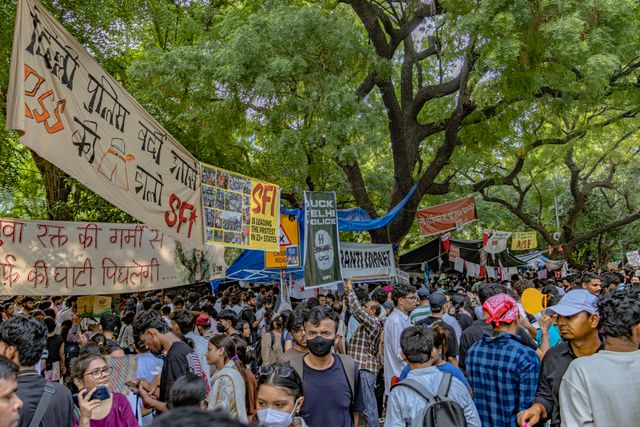

The right to protest is an essential feature of a democratic society. It allows citizens to question government decisions, challenge public policies, demand accountability, and express grievances that may otherwise receive limited attention. In India, peaceful protest is closely connected to the constitutional freedoms of speech and expression and peaceful assembly. However, the exercise of these rights frequently raises questions about public safety, traffic management, access to public spaces, and the responsibilities of law enforcement. The controversy surrounding Jantar Mantar in New Delhi has brought these competing interests into sharp focus.
On October 12, 2026, the Delhi Police withdrew Jantar Mantar’s designation as an authorised protest site and identified Ramlila Ground, Burari Ground, and CBD Ground in East Delhi as alternative venues. The decision followed recommendations from a committee constituted by the Union Ministry of Home Affairs and came amid heightened restrictions on demonstrations in central Delhi. The change was subsequently challenged before both the Supreme Court of India and the Delhi High Court, raising questions about whether relocating protests can adequately protect democratic expression.
The controversy is not simply about whether demonstrations should be permitted at one particular location. It concerns the broader relationship between the state and citizens who wish to communicate their demands directly to public institutions. Authorities have legitimate responsibilities to prevent violence, protect residents, maintain transport networks, and secure sensitive government areas. At the same time, restrictions that make peaceful protest inaccessible, expensive, or politically ineffective may weaken the practical value of constitutional freedoms.
The central question is therefore whether a protest site can be restricted without undermining the right it was intended to facilitate. Answering it requires examining constitutional protections, judicial precedents, the practical importance of protest locations, and the standards that should govern restrictions in a democratic society.
Why Jantar Mantar Matters in India’s Protest Culture
Jantar Mantar has developed into one of India’s most recognisable locations for public demonstrations. Its significance extends beyond the physical space available for a gathering. Located in central Delhi, it provides a visible platform from which citizens, civil society organisations, labour groups, student associations, and political movements can communicate their demands to institutions associated with national governance.
A protest is a form of public communication. Unlike a private letter or an online complaint, it places a collective demand in a shared physical space where journalists, policymakers, officials, and the wider public may encounter it. The location can influence the visibility of a demonstration, the likelihood of media coverage, and the symbolic force of its message. For groups with limited political influence, this visibility can be particularly important.
Jantar Mantar’s accessibility has also contributed to its importance. A designated protest site offers a recognised location where organisers can plan demonstrations within established rules. When the state permits citizens to gather at a known venue, it can help facilitate crowd management and reduce uncertainty for both protesters and the surrounding public.
However, the site’s history has also involved disputes over noise, waste, traffic, and disruption to nearby residents and offices. These concerns cannot simply be dismissed. People living and working near a protest venue retain their own rights to safety, accessibility, and reasonable use of public space. The challenge is to address these concerns without treating the presence of dissent itself as an undesirable activity.
What Triggered the 2026 Jantar Mantar Controversy?
The immediate controversy emerged during a period of heightened political demonstrations in Delhi. Protests concerning alleged irregularities in the Special Intensive Revision of electoral rolls and demands relating to the functioning of the Election Commission led to increased police deployment, barricading, and restrictions around central Delhi. The demonstrations and associated detentions intensified debate about the boundaries of lawful protest and the use of preventive policing.
On October 12, the Delhi Police formally de-notified Jantar Mantar as a designated protest site. The notification identified Ramlila Ground, Burari Ground, and CBD Ground as alternatives and stated that revised procedures for demonstrations at these locations would be issued separately. The decision was attributed to recommendations from a committee established by the Ministry of Home Affairs.
The change quickly became a legal and constitutional issue. Petitioners challenged the decision before the Supreme Court and Delhi High Court, questioning whether the alternative sites were suitable and whether removing Jantar Mantar from the list of authorised venues was consistent with earlier judicial protections for peaceful demonstrations. One argument concerned the potential costs associated with alternative grounds, which could make organising protests more difficult for groups with limited financial resources.
On October 15, the Supreme Court issued notice on a petition challenging the de-notification. Reports of the proceedings indicated that the court would examine whether the authorities had adequately considered the site’s use and effectiveness. As of October 22, the issue remains a live legal controversy rather than a question that can be treated as conclusively settled by a final ruling on the 2026 decision.
The dispute illustrates a wider constitutional concern: identifying an alternative venue does not necessarily establish that the right to protest remains equally accessible or effective. The practical consequences of relocation matter as much as the formal existence of another designated space.
The Constitutional Foundation of the Right to Protest
The Indian Constitution protects freedom of speech and expression under Article 19(1)(a) and the right to assemble peacefully and without arms under Article 19(1)(b). These provisions allow citizens to communicate political opinions, organise collective demonstrations, and participate in public debate. Peaceful protest is an important means through which these constitutional freedoms are exercised together.
Nevertheless, neither freedom is absolute. Article 19(2) permits reasonable restrictions on speech on specified constitutional grounds, while Article 19(3) allows reasonable restrictions on peaceful assembly in the interests of the sovereignty and integrity of India and public order. The existence of these limitations means that the state may regulate demonstrations, but it does not automatically justify every restriction imposed in their name.
The distinction between regulation and prohibition is crucial. Regulation establishes conditions under which a right can be exercised safely and fairly. Prohibition prevents its exercise altogether, either directly or through restrictions so extensive that the right becomes practically unavailable. A permission system may be legitimate when it helps authorities manage crowd size, provide emergency access, and protect surrounding communities. It becomes problematic when the process is arbitrary, opaque, or structured to prevent disfavoured groups from expressing their views.
A democratic interpretation of Article 19 therefore requires attention to both public order and the preservation of meaningful dissent. Authorities must identify the legal basis for restrictions, consider the circumstances of the proposed demonstration, and ensure that the conditions imposed remain proportionate to the risks involved.
What the Supreme Court Has Said About Protest Restrictions
The Himat Lal K. Shah Judgment
In Himat Lal K. Shah v. Commissioner of Police, Ahmedabad, decided in 1972, the Supreme Court considered the state’s authority to regulate public meetings in streets and public spaces. The judgment recognised that prior permission and reasonable regulation may be necessary. However, it also rejected the idea that authorities could effectively eliminate the right of assembly by prohibiting meetings across public places.
The underlying principle remains important to the Jantar Mantar dispute. The state may establish procedures for using public spaces, but those procedures must operate in support of the constitutional right rather than provide an unrestricted power to suppress it. A permission requirement should have clear criteria and should not become a mechanism through which every inconvenient or politically sensitive demonstration can be refused.
The Mazdoor Kisan Shakti Sangathan Judgment, 2018
The Supreme Court’s decision in Mazdoor Kisan Shakti Sangathan v. Union of India is particularly relevant because it directly concerned protests at Jantar Mantar and restrictions on demonstrations in central Delhi.
The case involved complaints from residents about noise, litter, and disruption caused by demonstrations, alongside challenges to measures that effectively prevented protests at the site. The Court recognised the importance of peaceful demonstrations while acknowledging the rights of residents and the need for orderly management of public spaces. It rejected an approach based on a complete ban and supported regulated use of a limited portion of Jantar Mantar Road for demonstrations.
The judgment established an important balancing principle: protecting one group’s rights should not require the total extinction of another group’s rights. Residents should not be forced to tolerate unlimited disruption, but protesters should not lose their constitutional freedoms merely because demonstrations create manageable inconvenience.
The ruling also recognised that the location of a protest can influence its purpose. Moving demonstrations farther from government institutions may reduce disruption in one area, but it may also reduce their ability to communicate demands directly to the authorities concerned. The appropriate response is therefore to evaluate the practical effects of relocation rather than assume that every alternative venue is equivalent.
The Shaheen Bagh Judgment and Public Spaces
In Amit Sahni v. Commissioner of Police, decided in 2020, the Supreme Court addressed the occupation of a public road during the Shaheen Bagh protests. The Court emphasised that public ways cannot be occupied indefinitely and that the rights of commuters and other members of the public must be protected.
This judgment reinforces the principle that protest rights coexist with other public interests. A demonstration cannot claim unlimited control over a road or prevent other citizens from using public infrastructure without reasonable limits. At the same time, the judgment should not be interpreted as eliminating the right to demonstrate. The task of public authorities is to establish workable arrangements that protect both peaceful dissent and the public’s access to shared spaces.
Together, these judgments establish a framework in which peaceful assembly is constitutionally protected, reasonable regulation is permitted, and blanket prohibitions require serious scrutiny. The controversy over Jantar Mantar turns on how faithfully that framework is applied.
Can Authorities Move Protests to Alternative Locations?
The strongest argument in favour of relocating demonstrations is that governments must manage competing demands on urban space. Central Delhi contains important public offices, busy transport routes, sensitive locations, and residential areas. Large gatherings may require substantial security deployment, affect traffic, obstruct access, or create safety risks. A properly equipped alternative site may provide better crowd-control arrangements, sanitation, emergency access, and facilities for participants.
Relocation can therefore be legitimate in appropriate circumstances. The Constitution does not guarantee protesters an unconditional right to demonstrate at every location they choose. Authorities may consider crowd capacity, proximity to sensitive buildings, anticipated disruption, and the feasibility of maintaining public safety.
However, an alternative venue must be evaluated in practical terms. Its distance from the institutions being addressed, public transport connections, accessibility for people with disabilities, availability of basic facilities, and financial cost can determine whether a protest remains realistically possible. A location that is technically available but prohibitively expensive or difficult to reach may offer only limited protection for groups with fewer resources.
The political significance of proximity also deserves consideration. A protest concerning a government department may be less effective if participants are moved far from the officials they are trying to reach. Visibility is not an incidental benefit of public assembly; it is often central to the way citizens communicate collective demands. Relocation that substantially diminishes this function may impose a greater restriction than authorities acknowledge.
Consequently, the relevant question is not simply whether another ground exists. It is whether that ground allows citizens to exercise their rights in a reasonably effective, accessible, and safe manner.
The Difference Between Public Order and Administrative Convenience
Public order is a legitimate constitutional concern, but it should not become a general justification for suppressing demonstrations. The Supreme Court has distinguished broader threats to public order from ordinary disturbances or inconvenience. The fact that a gathering may require traffic management, additional police personnel, or temporary changes to public access does not automatically establish that the demonstration presents a threat sufficient to justify severe restrictions.
Authorities should therefore assess risks on the basis of specific circumstances. The anticipated size of a gathering, credible threats of violence, the availability of emergency routes, and evidence of likely serious disruption may justify tailored conditions. These could include limits on attendance, designated hours, sound restrictions, route adjustments, and arrangements for maintaining cleanliness.
By contrast, broad restrictions based primarily on speculation, political sensitivity, or the possibility that a protest might attract public attention risk undermining constitutional freedoms. A democratic system must tolerate a degree of inconvenience arising from peaceful public participation. If administrative convenience always takes priority over dissent, the right to assemble may remain present in constitutional language while becoming increasingly difficult to exercise in practice.
How Restrictions Can Affect Democratic Expression
The impact of protest restrictions is not distributed equally. Established political organisations may have the resources to obtain permissions, hire transport, arrange equipment, and organise gatherings at distant venues. Smaller community groups, workers, students, pensioners, and individuals seeking redress may have far fewer resources. Additional costs and complicated procedures can therefore discourage participation even when a formal right remains available.
Restrictions can also affect the media visibility of demonstrations. Public protest depends partly on the ability of citizens to bring their concerns into a shared national conversation. A location far from political institutions or ordinary media routes may reduce the likelihood that a demonstration will receive attention. This does not mean every protest must occur outside a government office, but it does mean that location should be considered when evaluating the proportionality of restrictions.
Another concern is the potential for unequal enforcement. If organisers believe that permissions are granted inconsistently or that similar demonstrations receive different treatment depending on their political positions, public confidence in the administration of protest rules may decline. Transparent criteria and written reasons for refusals can help reduce this risk.
The broader democratic consequence is that citizens may become less willing to participate in public life when lawful dissent appears inaccessible. A system that facilitates peaceful expression can help channel grievances into visible, organised, and manageable forms. A system that unnecessarily restricts it may deepen mistrust between institutions and the people they serve.
Finding a Practical Balance Between Safety and Freedom
A balanced approach requires more than designating alternative grounds. Authorities should publish clear and consistent procedures explaining how organisers can apply, how applications will be assessed, what conditions may be imposed, and how refusals can be challenged. Decisions should be supported by specific reasons and should be communicated sufficiently early to allow organisers to make practical arrangements.
The suitability of alternative sites should also be evaluated transparently. Authorities should disclose relevant information about capacity, accessibility, transport, facilities, costs, and emergency arrangements. Where a protest at a particular location presents manageable risks, less restrictive measures should be considered before relocation or prohibition.
Consultation can improve the quality of these arrangements. Police, municipal authorities, residents’ associations, transport agencies, and protest organisers can work together to establish rules that reduce disruption without eliminating meaningful access to public spaces. Such cooperation should not give any one group an unlimited veto over peaceful assembly. Instead, it should help identify practical safeguards that protect the legitimate interests of everyone affected.
Judicial review remains an important safeguard where authorities act arbitrarily or impose disproportionate restrictions. Courts can examine whether a decision has a lawful basis, whether relevant factors were considered, and whether less restrictive alternatives were available. Clear standards and effective review can help ensure that public safety is not used as a pretext for suppressing lawful dissent.
Conclusion: Regulation Must Preserve the Right It Governs
The Jantar Mantar controversy exposes a fundamental question about democracy: can the state control the location of dissent without weakening the ability of citizens to be heard? The answer depends on how restrictions are designed, justified, and implemented. Governments have a legitimate responsibility to maintain public order, protect residents, and ensure the safe use of public spaces. Yet these responsibilities must be exercised consistently with the constitutional freedoms of speech and peaceful assembly.
The Supreme Court’s earlier decisions establish that peaceful protest is a protected democratic activity, that reasonable regulation is permissible, and that blanket prohibitions can undermine constitutional rights. The 2026 de-notification of Jantar Mantar must therefore be assessed not only by reference to the existence of alternative grounds, but also by examining their accessibility, affordability, effectiveness, and suitability for different kinds of demonstrations.
A protest site is more than a patch of land. It is a public platform through which citizens communicate with institutions, seek accountability, and participate in democratic life. Relocation may be justified when supported by clear reasons and proportionate safeguards, but it should not turn the right to protest into a privilege available only to those who can afford the distance, expense, and administrative burden.
Ultimately, a democratic government should not be required to accept every protest at every location without conditions. It should, however, ensure that the rules governing peaceful assembly enable citizens to exercise their constitutional freedoms meaningfully. Public order and democratic expression are not necessarily opposing objectives. With transparent procedures, proportionate restrictions, accessible venues, and effective judicial oversight, they can be protected together. The legitimacy of restrictions on Jantar Mantar will depend on whether they achieve that balance or make peaceful dissent less visible, less accessible, and less effective.
Online Internship with Certificate
You may be interested

When a Case Is Solved Years Later: How Forensic Advances Can Reopen Cold Investigations
Anshika Jain - Oct 22, 2026Some criminal investigations remain unresolved for years or even decades. Witnesses may be unable to identify a suspect, investigators may exhaust the available leads, and physical evidence…
Gold Smuggling Through Airports: How Investigators Trace Possible Links
Anshika Jain - Oct 22, 2026International airports are essential gateways for tourism, trade and global connectivity. Every day, thousands of passengers, airline employees, ground handlers, cargo workers and service providers move through…
Why Restrictions on Journalists Covering Protests Raise Questions About Press Freedom
Anshika Jain - Oct 22, 2026Public protests are among the most visible expressions of democratic participation. They provide citizens with an opportunity to challenge government decisions, demand accountability, raise concerns about injustice…
Most from this category

Political Allegations Versus Verified Evidence: How Readers Can Separate Claims from Facts
Anshika Jain - Oct 22, 2026
Voter List Revision in India: How Can Citizens Verify That Their Names Have Not Been Omitted?
Anshika Jain - Oct 22, 2026
Six Years of Arrest Delays: What the Delhi Court’s MCOCA Criticism Reveals
Anshika Jain - Oct 21, 2026

Political Allegations Versus Verified Evidence: How Readers Can Separate Claims from Facts
Anshika Jain - Oct 22, 2026Voter List Revision in India: How Can Citizens Verify That Their Names Have Not Been Omitted?
Anshika Jain - Oct 22, 2026Six Years of Arrest Delays: What the Delhi Court’s MCOCA Criticism Reveals
Anshika Jain - Oct 21, 2026